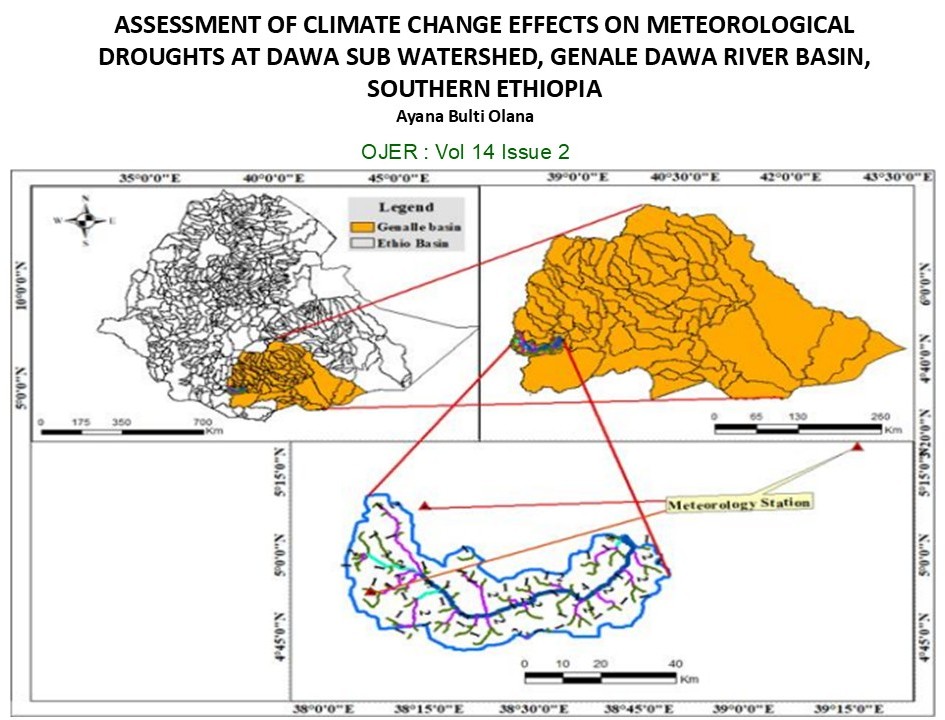
ASSESSMENT OF CLIMATE CHANGE EFFECTS ON METEOROLOGICAL DROUGHTS AT DAWA SUB WATERSHED, GENALE DAWA RIVER BASIN, SOUTHERN ETHIOPIA
Oromia Agricultural Research Institute, Mechara Agricultural Research Center, Department of Irrigation and Drainage Engineering, Mechara, Ethiopia
This study investigates the influence of climate change on meteorological drought patterns in Ethiopia, Africa using CMIP5-based GCM-RCM ensembles under RCP4.5 and RCP8.5 scenarios. Bias-corrected daily temperature and precipitation data (via CMhyd) and DrinC drought indices were employed to characterize drought dynamics. The HBV Light hydrological model was calibrated (1991–2010) and validated (2011 to 2020), yielding strong performance (R²=0.88/0.86; NSE = 0.77/0.83). Results indicate a decline in mean annual discharge (1.6–3.5% under RCP4.5; 4.6 to 4.9% under RCP8.5), while Belg season flows increased by ~39–40% in the 2020s and ~38–39% in the 2050s, reflecting altered precipitation patterns. These findings support early warning systems and inform adaptation strategies. Recommended measures include soil and water conservation, drought-tolerant crops, and water harvesting. Future research should integrate wet day frequency to improve drought prediction under evolving climate conditions.